Quarters on the Dollar: The Decades-Long Story of How Big Retail Shortchanged Retro Gamers at the Trade-In Counter
Somewhere out there, somebody handed over a mint-condition copy of Earthbound for a fistful of store credit and walked away feeling pretty good about themselves. Maybe they bought a used copy of Madden with it. Maybe they grabbed a discount memory card. Either way, they left behind something that the market would eventually value at several hundred dollars — sometimes more — and took home a fraction of what it was actually worth.
This wasn't a freak accident. It was policy.
For the better part of three decades, corporate trade-in programs at major retailers operated on a simple, ruthlessly effective premise: the customer doesn't know what they have, and we do. Or at least, we know enough to make money on the spread. The result was a systematic transfer of wealth — measured in cartridges, discs, and accessories — from living rooms across America into the resale pipeline of big-box retailers who then flipped those same games at healthy markups the same afternoon.
The Machine Behind the Price Tag
Understanding why trade-in valuations were so consistently low requires a look at how those numbers were actually generated. Retailers didn't employ teams of passionate collectors who stayed up late studying eBay sold listings. They used internal pricing databases — proprietary systems updated on irregular schedules that lagged significantly behind actual market conditions.
Former retail managers who worked the trade-in counter during the early 2000s have described the process as more clerical than analytical. You scanned the barcode. The system spat out a number. You offered the customer that number. There was little room for nuance, and almost no mechanism to account for regional scarcity, condition premiums, or the kind of collector demand that drives real-world prices.
The databases themselves were built to protect margin, not to reflect fair market value. A game's trade-in value was typically set at a percentage of the retailer's own used selling price — itself often already below the collector market — which meant the gap between what you received and what the game was actually worth could be staggering.
The Games That Got Away
The damage wasn't evenly distributed. Common titles — sports games, licensed movie tie-ins, the kind of stuff that flooded shelves by the millions — were probably priced close enough to their real value that nobody lost sleep over the difference. But the rare stuff? The limited print runs, the niche RPGs, the late-generation releases that shipped in small quantities because the console was already dying? Those were where the system really broke down.
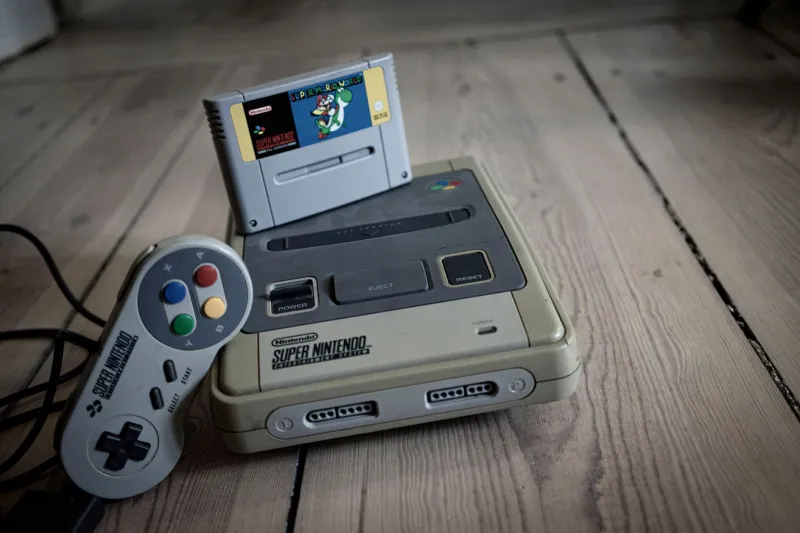
Consider the Super Nintendo era. By the late 1990s, the SNES was being phased out, and plenty of its best games were already becoming scarce. A retailer's pricing database, built around volume movement and average demand, had no real way to flag that Final Fantasy III (known in Japan as VI) or Chrono Trigger were quietly becoming something special. The system saw old inventory. Collectors, if they were paying attention, saw the beginning of a gold rush.
The same pattern repeated with the Nintendo 64, the original PlayStation, and later the Game Boy Advance. By the time a game's collector value was undeniable, most of the cheap copies had already cycled through trade-in counters and into the hands of people who understood what they were buying.
Who Actually Knew What Was Going On
Here's the uncomfortable part: the knowledge gap wasn't symmetrical. While the average customer had no real way to research trade-in fairness — remember, this was before smartphones put a price guide in everyone's pocket — the people running the used game ecosystem often had a much clearer picture.
Store managers with a genuine interest in gaming sometimes tried to work within the system to flag undervalued titles, but they were operating inside corporate structures that weren't designed for that kind of flexibility. The pricing came from above. Deviating from it meant paperwork, exceptions, and friction that most locations simply weren't set up to handle.
Meanwhile, a parallel ecosystem of savvier buyers — the folks hitting garage sales on Saturday mornings, the early eBay adopters, the collectors who were already treating certain cartridges like investments — was quietly picking up the slack. They understood the arbitrage. They bought low from people who didn't know better, sometimes including the retailers themselves during clearance events, and they held on.
The Store Credit Trap
There's another layer to this story that doesn't get enough attention: the psychology of store credit. A cash offer and a store credit offer of the same nominal amount are not the same thing, but they feel equivalent in the moment. Retailers leaned into this. Store credit could only be spent in one place, which meant the transaction didn't end at the trade-in counter — it continued into the new release section, the accessories wall, the impulse-buy endcap.
The customer who might have hesitated at a $4 cash offer for a game they'd paid $50 for often accepted a $6 store credit offer without complaint, because $6 felt like more. And then they spent that credit on something the retailer had marked up accordingly. The house always won twice.
What the Data Eventually Revealed
As collector communities matured through the 2000s and into the 2010s, price tracking became more rigorous. Sites dedicated to cataloging sold listings, forums where collectors compared notes, and eventually dedicated pricing databases gave regular gamers the tools to actually see the gap. The results were often jaw-dropping.
Games that had been accepted at trade-in counters for single-digit store credit were selling in collector markets for ten, twenty, sometimes fifty times that amount. The spread wasn't a rounding error. It was structural.
How to Protect Yourself Today
The big-box trade-in era is largely behind us — the retail landscape has shifted dramatically — but the underlying dynamic hasn't disappeared. Secondhand marketplaces, pawn shops, and even some modern gaming retailers still operate on information asymmetry. The seller who doesn't do their homework is still the one who loses.
A few habits that every collector should build before selling anything:
Check sold listings, not asking prices. What a game is listed for and what it actually sells for are two different numbers. Platforms that show completed transactions give you real market data.
Condition matters more than you think. A cartridge with a torn label and a cracked case is not the same product as a clean, complete-in-box copy. Price accordingly.
Rare doesn't always mean obvious. Some of the most undervalued games look completely unremarkable. Do your research on any title before you let it go, especially late-era releases on systems you're clearing out.
Local collector communities are your friend. Facebook groups, Discord servers, and regional retro gaming meetups put you in contact with buyers who understand value. They may offer more than a retailer ever would, because they're buying for love, not margin.
Patience is a pricing strategy. If you're not in a hurry to sell, you don't have to take the first offer. The market for classic games has historically rewarded people who held on.
The Lesson the Vault Teaches
The trade-in era left behind a generation of collectors who unknowingly liquidated pieces of gaming history for bus fare. Some of those games are gone — worn down by the resale cycle, lost to poor storage, or sitting in collections where their original owners will never find them. The ones that survived are now priced accordingly.
The real takeaway isn't bitterness, though it's understandable. It's awareness. The PixelVault ethos has always been about treating classic games as the cultural artifacts they are — things worth preserving, understanding, and yes, valuing properly. The trade-in counter never shared that philosophy. It's on collectors to make sure they do.