The Stick That Started It All: How 1980s Arcade Patents Still Shape the Controllers in Your Hands
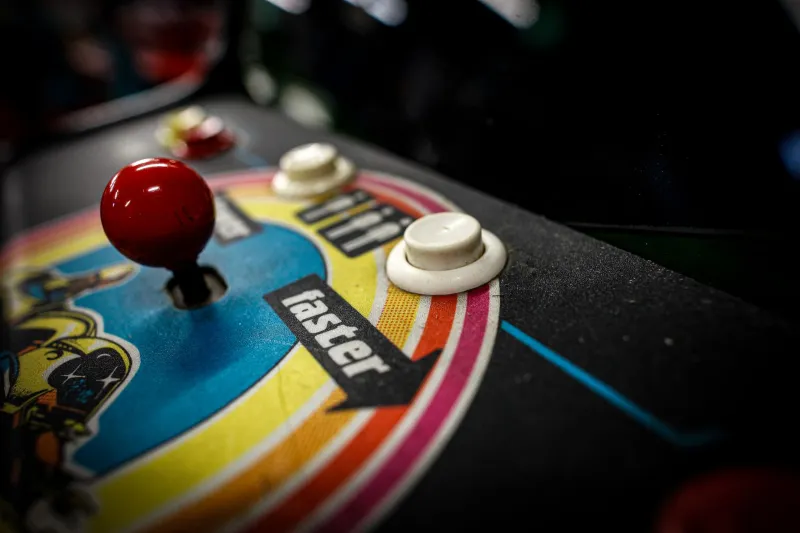
Pick up a quality arcade stick today — the kind serious Street Fighter players use at tournaments, the kind that fighting game communities debate endlessly on Reddit — and you're holding something with older bones than you might expect. The mechanical principles inside that stick, the geometry of the gate, the tension of the spring, the way the microswitches register your inputs: a meaningful chunk of that engineering was figured out in the late 1970s and early 1980s by people who were building machines for bowling alleys and pizza parlors.
That's not a knock on modern hardware. It's actually a testament to how well some of those original designers understood what human hands need from an input device.
The Golden Age Solved a Hard Problem
Building a good joystick is harder than it looks. You're trying to translate the analog, imprecise movement of a human wrist into discrete digital signals that a game can act on — and you need to do it fast, reliably, and in a way that doesn't feel like you're fighting the hardware instead of the game. Arcade manufacturers in the late 1970s had powerful financial motivation to get this right. A stick that felt bad meant players walked away, and players walking away meant empty coin slots.
The solutions that emerged during that period were remarkably sophisticated. The eight-way gate design — the octagonal or square plastic guide that constrains a joystick's range of motion — became standard because it gave players tactile feedback about which direction they were holding without requiring them to look down. The specific throw distance (how far the stick travels before registering input) was tuned through iteration based on actual player behavior. Microswitch actuation forces were calibrated to feel responsive without causing hand fatigue during extended sessions.
Sanwa and Seimitsu, two Japanese manufacturers that supplied hardware to arcade operators across Asia and eventually the United States, refined these designs across dozens of product iterations. Their sticks became the de facto standard in Japanese arcades, which meant they became the standard for the fighting game genre — because the fighting game genre was essentially invented in Japanese arcades.
Patents, Licensing, and the Long Shadow of Arcade IP
Here's where the history gets genuinely interesting from an intellectual property standpoint. The core mechanical innovations in quality joystick design were patented, and those patents created licensing relationships that persisted long after the original arcade boom faded. When American manufacturers started producing arcade sticks for the home console market in the early 2000s — riding the wave of renewed interest in fighting games sparked by the Street Fighter IV announcement — they had choices to make.
Some licensed the genuine article. Others reverse-engineered the key mechanical elements closely enough to avoid direct infringement while preserving the functional characteristics that made the originals work. Either way, the mechanical DNA of 1980s arcade engineering was traveling forward through time.
The fighting game community, famously particular about their hardware, noticed. Forum threads comparing the feel of different stick mechanisms stretch back decades and read like engineering dissertations. Players can articulate the difference between a Sanwa JLF and a Seimitsu LS-32 in terms that would be at home in a product review journal. This isn't audiophile-level placebo effect — the mechanical differences are real and measurable, and their effects on gameplay are meaningful enough that tournament players have genuine preferences.
Why the Originals Still Win the Argument
There's a case to be made — and retro players make it loudly — that the original arcade hardware still outperforms modern alternatives in several meaningful ways. Part of this is genuine engineering quality. Sanwa and Seimitsu components built for commercial arcade use were designed to handle millions of actuations in high-traffic environments. The tolerances are tight and the materials are durable in ways that budget-oriented modern alternatives often aren't.
But part of it is something harder to quantify. There's a tactile language that develops between a player and a specific input device over years of use. Players who learned Street Fighter II on actual arcade hardware in the early 1990s built muscle memory calibrated to the specific feel of those machines. When they pick up a modern stick using genuine Sanwa components, that muscle memory transfers cleanly. When they use a cheaper alternative with different spring tension or actuation characteristics, something feels off — even if the specs on paper are similar.
This is why the retro gaming community's preference for original hardware isn't purely nostalgic. For competitive play especially, the originals represent a known quantity with a proven track record. A Sanwa JLF-TP-8YT that was installed in a Capcom cabinet in 1994 and a new one pulled from a bag today should perform identically. That consistency across decades is genuinely remarkable.
What the Fighting Game Community Preserved
It's worth stepping back and appreciating what the FGC — the fighting game community — actually accomplished by maintaining such strong opinions about their hardware. By refusing to accept compromised alternatives and continuing to demand authentic arcade-spec components, they created sustained market demand for products that might otherwise have disappeared entirely.
Sanwa and Seimitsu are still in business. They're still manufacturing joystick components. The mechanical designs that were refined in 1980s Japanese arcades are still being produced because a community of passionate players decided those designs were worth preserving through the most direct means available: buying them.
That's a form of preservation that doesn't get talked about much in retro gaming circles, which tend to focus on cartridges and consoles. But the input devices — the sticks and buttons that form the physical interface between player and game — are just as much a part of gaming history. And in this particular case, history never actually ended. It just moved from the arcade floor to the tournament stage.
The joystick that helped someone beat their high score on Galaga in 1982 and the stick helping someone climb ranked ladders in Street Fighter 6 today are, in the ways that matter most, the same joystick. That's either a comforting thought or a slightly mind-bending one, depending on how you feel about the passage of time.