Don't Get Played: A Collector's Field Guide to Buying Vintage Arcade Cabinets at Estate Sales
You're scrolling through an estate sale listing on a Saturday morning and there it is: a Pac-Man cabinet, original Midway artwork, sitting in some guy's garage in suburban Ohio. The photos look decent. The asking price seems almost reasonable. Your heart rate goes up a little.
Stop. Take a breath. And read this article before you do anything else.
Vintage arcade cabinets are among the most rewarding things a serious retro collector can own — and among the easiest to get burned on. Unlike a cartridge or even a console, an arcade cabinet is a complex electromechanical system that can hide thousands of dollars in repair costs behind a coat of paint and a working attract mode. Estate sale sellers rarely know what they have, which cuts both ways: you can occasionally find legitimate deals, but you can just as easily overpay for a basket case.
We talked to restorers, arcade operators, and veteran collectors across the US to pull together the practical knowledge that separates a smart buy from an expensive mistake.
Before You Even Walk In the Door
The work starts before you show up. If you have photos from the listing, use them. Look at the monitor — is there any visible burn-in, discoloration, or geometric distortion visible in the image? Check the condition of the control panel overlay; cracks, peeling, and water staining are visible even in phone photos if you know to look. Most importantly, try to identify exactly what you're looking at.
"A lot of buyers show up not knowing the difference between an original dedicated cabinet and a conversion," says Dave, who runs a cabinet restoration shop outside of Chicago and has been working on arcade hardware since the early 2000s. "Conversions aren't necessarily bad, but they're worth less than a dedicated original, and sellers — even honest ones — often don't know the difference themselves."
A dedicated cabinet was built specifically for one game. A conversion is a cabinet that originally ran a different game and was later retrofitted. The arcade industry did this constantly during the golden age; operators would swap out boards and artwork to keep machines fresh without buying new cabinets. A Galaga conversion in a generic Bally cabinet is a legitimate piece of arcade history, but it's not the same as an original Galaga dedicated unit, and the price should reflect that.
Do your homework on the specific title you're looking at. The KLOV (Killer List of Videogames) database is the gold standard reference for cabinet specifications, original artwork details, and hardware configurations. If the seller's photos don't match what KLOV says the original should look like, you're probably looking at a conversion or a reproduction.
What to Inspect When You Arrive
You've made the drive. You're standing in front of the machine. Here's your checklist, roughly in order of importance.
The monitor. This is where your most expensive potential repair lives. CRT monitors in arcade cabinets are increasingly difficult and costly to service. Turn the machine on and let it run for at least 15 minutes before evaluating the display. Look for burn-in (ghost images from the attract mode permanently etched into the phosphors), color convergence issues (where the red, green, and blue layers don't align properly), and brightness uniformity. A monitor that looks fine when cold can develop significant problems after it warms up. Budget $200 to $600 for a professional CRT restoration if it needs work — and that's assuming a repairable unit. Some monitors are simply done.
The PCB. The game board is the brain of the machine. If possible, bring a flashlight and look at the board for corrosion, burnt components, or evidence of amateur repair work. Cracked solder joints, scorched traces, and suspiciously replaced chips are all warning signs. If the game plays perfectly through a full credit cycle with no graphical glitches or sound issues, that's a good sign — but it's not a guarantee.
The cabinet itself. Check the bottom corners and the base for water damage. Swollen particle board is essentially irreparable and structurally compromises the whole cabinet. Look for evidence of mice — chewed wiring and droppings in the bottom of the cabinet are unfortunately common in machines that spent years in garages or storage units. Check the coin door for original locks and mechanisms.
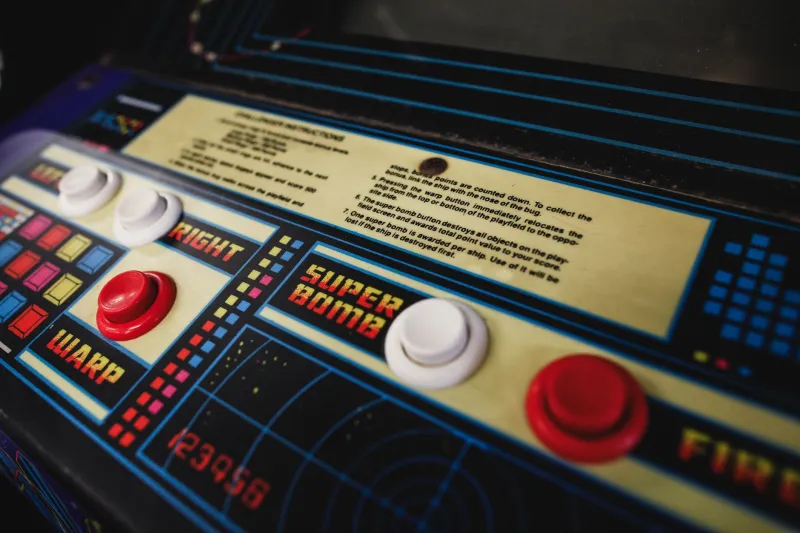
The artwork. Side art, marquee, control panel overlay, and bezel condition all affect value significantly. Reproduction artwork is available for most popular titles, which is great for restoration purposes but also means a machine can be dressed up to look more original than it is. Original artwork has subtle characteristics — texture, aging patterns, specific printing quirks — that reproductions don't perfectly replicate. If something looks too crisp and too perfect on a machine that's supposed to be 40 years old, ask questions.
The Reproduction Problem
This is where things get genuinely complicated. The arcade collecting community has a healthy restoration culture, and reproduction parts — artwork, control panels, even entire cabinet shells — are widely available and widely used. A restored cabinet with reproduction artwork and a recapped monitor is still a legitimate collectible to most people in the hobby.
The problem is when reproduction hardware is sold as original without disclosure, whether intentionally or through ignorance. Full reproduction cabinets — brand-new builds made to look like originals — exist for popular titles like Donkey Kong and Centipede, and they can be surprisingly convincing to an untrained eye.
"The tells are usually in the wood and the hardware," says Rachel, an arcade operator in the Pacific Northwest who has bought and sold hundreds of machines over the years. "Original cabinets used specific grades of plywood and specific joinery methods. New builds, even good ones, tend to use modern materials that look subtly different when you know what you're looking for. The screws are often a giveaway — original hardware used specific fastener types that you just don't see in reproduction builds."
For high-value targets like original Pac-Man or Donkey Kong dedicated cabinets, it's worth connecting with the collector community before buying. Post the listing photos in relevant Facebook groups or subreddits and ask for opinions. The arcade collecting community is generally generous with expertise, and experienced eyes can often spot problems in photos that a first-time buyer would miss entirely.
Pricing Reality Check
Estate sale pricing on arcade cabinets is all over the map. Sellers who know what they have will price accordingly; sellers who don't may go either direction. A non-working common title like Asteroids or Centipede in rough shape might be worth $100 to $200 as a project. A fully working, original-condition dedicated Pac-Man cabinet can legitimately command $1,500 or more.
The key is always to factor in your restoration budget before you commit. A machine that needs a monitor recap, a new control panel overlay, and PCB work can easily absorb $500 to $1,000 in parts and labor on top of the purchase price. Know what you're willing to spend total, not just what the seller is asking.
And never, ever skip the test play. If a seller won't let you power up the machine and run through a full game, walk away. There's no legitimate reason to refuse that request, and a working machine is the single most important factor in any arcade cabinet purchase.
The right cabinet at the right price is one of the great joys of retro collecting. The wrong one is an expensive, space-consuming lesson. Do your homework, take your time, and don't let the excitement of the find override the discipline of the inspection. The pixels will still be there after you've done your due diligence.